
Slida Development
Introduction
Slida was created during the summer of 2024 for a module at university. The brief for the assignment was very open, allowing us to create and submit any type of digital artifact. I decided to make a game using Gamemaker, the tool I have the most experience with. Going into this assignment, I had a few personal goals that I wanted to accomplish:
- I wanted to practice adding more “juice” to a game. I’ve always thought that if you can make actions that the player does frequently feel fun to do, your game will be much better as a result. I wanted every action to have a lot of feedback in this game.
- I wanted to make a puzzle game. This year in my group project I oversaw designing certain puzzles, and while I did create a few decent puzzles in the end, I wasn’t very happy with how I performed. I want to train my ability to design engaging puzzles.
- I wanted to develop my art style further. Around the time Slida was made my art style was a lot less defined than it is now, and I wanted to try deviating from the monochromatic look that my other works have. I wanted to stick with pixel art but attempt to use more than two colours (scary!). I also wanted to try something a little weird and abstract, as this was a direction I was interested in taking my current project, “Psycho-kin” on.
Development
When creating Slida, I challenged myself to build the project in around a week. I did this to help improve my skill at developing quickly and under pressure. I also find that when I have a large time frame to complete a project, I struggle to decide which direction to take it, so thought this arbitrary time frame might help me with that.
When ideating for what kind of game I wanted to make, I started by building on a starting idea I had of snappy grid-based movement. I had been thinking about how I could make the game feel amazing to play if the movement was great, and quickly snapping from tile to tile could be great if done well. I landed on the idea of a puzzle game where the player must move from one part of the stage to a goal in a limited number of moves. I wanted to keep the mechanics simple – I thought this would force me to be more creative with my puzzles. I planned for a simple enemy that only moves when the player does in a set pattern, making you lose if you both go onto the same tile at the same time. I also wanted to add a “fruit” pickup that would give you some more moves or “stamina” upon being collected.
I managed to design out a few stages that pushed the mechanics as far as they could go. I started with some easy levels to introduce the player to each mechanic separately, then combined them in the later levels. I worked hard on making the movement feel good, which shows in the final game. I also used various photos from places that were close to me for the backgrounds, then programmed a shader to distort them across the screen to give the game a little more soul.

The first room of the game
Conclusion
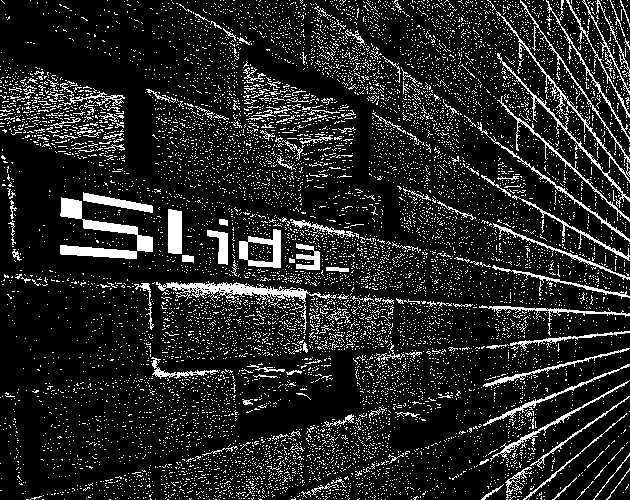
With the features and levels I wanted in-game, The project was complete. I decided to compile it to HTML5 so that it could be played on browser which works nicely for a game of its nature. I also made a piece of key art for the game that was more in line with the other pieces of my portfolio. It was made by taking a photo of the brick wall of my house and editing it, and I’m proud of it. I’ve been developing my digital art skills, and it fits the style I’m going for. Overall, I think I met my goals with this project. The game has plenty of “juice” and the art style is where it wants to be. I also think the puzzles are well designed and complement the mechanics of the game well.
Gameplay screenshots


